


Something changed somewhere between the first calorie counter and the most recent mood-tracking dashboard. Instead of just observing us, the phones we carry began to measure us. And an increasing number of people are being pulled under by that silent, ongoing measurement.
People are still shocked to learn that eating disorders have the highest mortality rate of any mental illness. Around 70 million people worldwide are affected, and the number is startling. However, a study conducted in the US revealed that nearly 86% of individuals who tested positive for an eating disorder never got treatment. Health apps were meant to bridge that gap, which is enormous and unyielding. They have, in certain respects. In others, they’ve made things more bizarre and difficult to identify.
You won’t have to try to find it if you stroll through any university library during exam season. MyFitnessPal is open, phones are face-up on desks, and a tiny green checkmark is glowing where a meal once was. A girl reads the label twice by tilting her water bottle. Every fourteen seconds, a boy using the elliptical looks at his watch. The apps are tracking, nudging, and rewarding users as promised. What else are they doing, I wonder?
In a recent qualitative study conducted in the UK and published this year in JMIR Formative Research, eighteen adults—men and women, including those from minority ethnic backgrounds—who had experienced eating disorders were asked, in essence, what these apps had done for and to them. The researchers employed a technique known as the COM-B model, which sounds clinical but is actually a fairly humane way of asking: what gives a person the opportunity, motivation, and capability to change a behavior, and what subtly takes those things away? The results, which were mapped across 13 of 14 theoretical domains, revealed that the apps people use to seek assistance frequently fail to identify the underlying causes of their illness.
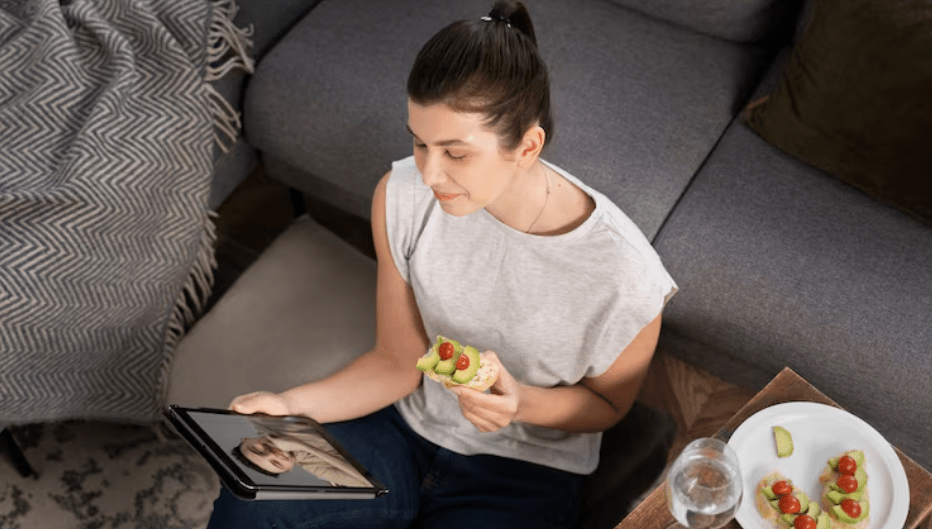
Reading the results gives the impression that the developers of these apps and the users have been talking over each other for years. Food logs, mood logs, and generic motivational pings—the digital equivalent of a coach shouting, “You’ve got this!” from a distance—remain the mainstays of commercial offerings. That numerical logging isn’t neutral for someone who has strong cognitive control or simmering perfectionism. It’s an accelerant. One participant reported that using a tracking app made them feel worse rather than better, with entering each almond turning into a little ritual of shame.
The researchers realized that the problem isn’t just what the apps contain, but also how they deliver it. This is something worth considering. When a behavior modification strategy is applied incorrectly, it can exacerbate the disorder it was intended to treat. That sentence has a loud implication despite being quiet. It indicates that the wellness industry, which is worth hundreds of billions of dollars and is still growing, has been based on presumptions that might not hold up to careful examination.
In other words, the one-size-fits-all model created primarily for white women has been failing almost everyone else, including the men and minority participants whose experiences seldom make it into the design rooms. The study found that sex and cultural background moderated almost every domain examined. It’s difficult to ignore how frequently that pattern appears in the field of digital health.
Perhaps the apps will improve. Some researchers are making a sincere effort to map behavioral mechanisms onto features with something approaching genuine care, working with individuals who have experienced the worst of it. It is another matter entirely whether they are followed by the larger market, which benefits from streaks, badges, and mild daily pressure. Millions continue to log for the time being. The phone continues to count. And somewhere in the silence between alerts, someone who came for assistance is learning how to vanish once more.
