


These days, Jensen Huang has a certain confidence that makes earnings calls worth listening to. Not exactly bravado. Something more subdued. He tells investors that he is doubling his prediction for AI chip orders to a trillion dollars through 2027 while standing there in the recognizable black leather jacket, his hair now completely silver. He says it in a manner similar to how someone else might announce a minor change to the menu. Most investors appear to believe him. The stock hardly moved.
Admittedly, it is difficult to dispute the figures supporting that confidence. Data center sales alone brought in about $75 billion of Nvidia’s $81.62 billion Q1 revenue, an 85% increase over the previous year. Net income surpassed $58 billion. These numbers place the quarterly output of a single company in the range of mid-sized national economies—a statement that five years ago would have been laughed at.
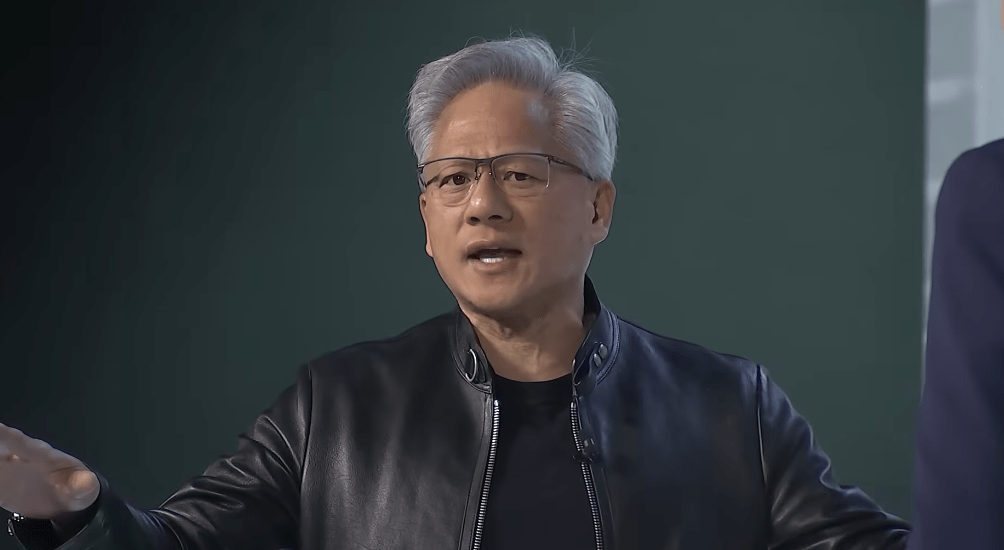
It’s difficult to ignore how rapidly Huang’s framing has changed. Fortune published a profile of him in 2017 that basically started, “You’ve probably never heard of him.” By 2024, Mark Zuckerberg was comparing Huang to Taylor Swift in Instagram pictures of the two of them exchanging jackets. During Computex that year, he was followed by large crowds throughout Taipei. Taiwanese media first used the term “Jensanity.” As you watch that metamorphosis take place, you begin to question whether Huang or anyone else truly comprehends who he has become.
The origin story—the Denny’s booth in East San Jose, the $200 in his pocket that the lawyer demanded, and the three founders sketching out a graphics-chip company over cheap coffee—has been recounted enough times to feel almost legendary. The fact that Nvidia nearly perished in those early years is something that is rarely discussed. Before the RIVA 128 saved them in 1997, they had only one month’s worth of payroll. The company was thirty days away from going out of business, Huang used to say at the beginning of staff presentations. Apparently, that habit persisted for years.
Speaking with those who follow the company gives the impression that this period of dominance isn’t unbreakable. The China issue keeps coming up. In an interview this week, Huang stated that Beijing has “all the chips they need” and that Huawei is “flourishing,” which sounds honest until you consider that Nvidia has now mostly given up on that market. A day earlier, CNBC reported the same thing. Whether that retreat is a short-term setback or the beginning of something bigger is still unknown.
In the meantime, Huang has focused on CPUs, a market that is presently dominated by AMD and Intel, the latter of which is led by his cousin Lisa Su—a family detail that seems invented but isn’t. It’s a $200 billion opportunity, according to him. There will soon be a Vera Rubin platform. He claims that Blackwell’s sales are unbelievable. Earlier this year, he was appointed to the Trump administration’s science and technology advisory council.
Observing all of this, it’s remarkable how little the man appears to perform. He wanders between conference rooms at Nvidia’s headquarters rather than maintaining an office. There are sixty direct reports. He chose not to wear a watch. It’s difficult to put into words how the flat structure, the years he spent being bullied at a Kentucky reform school he was mistakenly enrolled in, and the dishwashing job he started at a Denny’s in Oregon at the age of 15 all seem relevant.
He likes to quote $85 trillion for AI infrastructure over the next 15 years, but this figure is truly dubious. Long-term forecasts are often inaccurate in interesting ways. However, Huang has previously made mistakes regarding timing and, for the most part, direction. That’s probably the part that’s worth enduring.
