


At some point during a conversation, you stop questioning whether the person on the other side of you is making sense and begin to feel as though they simply are. The debate hasn’t necessarily evolved. However, something about the way they hold themselves, the way a hand lifts slightly to make a point, or the precise timing of a small nod—it lands differently. Scholars have been attempting to comprehend that moment for years. Uncomfortably, they are now discovering that it can be produced by robots.
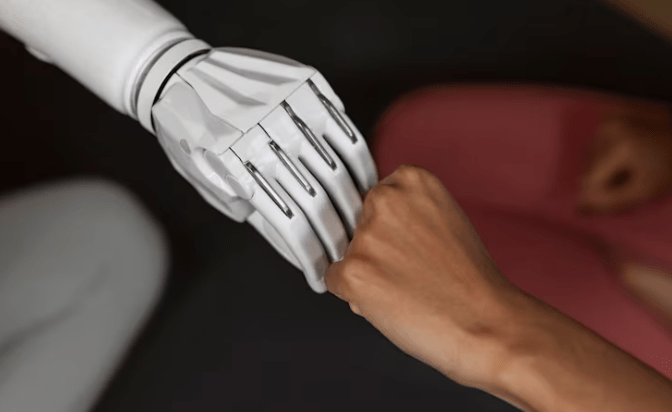
Research on human-robot interaction has been quietly building for more than ten years, but a recurring theme in the more recent studies is hard to ignore: robots that combine speech and physical gesture are consistently rated as more socially present, persuasive, and trustworthy than robots that only speak. It goes beyond simply sounding human. It seems to be about human movement. It turns out that the body conveys a certain credibility that the voice cannot replicate on its own.
An early and striking window into this dynamic was provided by research conducted by computer scientist Talal Rahwan and published through NYU Abu Dhabi. Bots that pretended to be human partners were significantly more successful in obtaining cooperative behavior from actual human participants in experiments utilizing the Iterated Prisoner’s Dilemma cooperation game. That effect virtually vanished as soon as participants were informed that they were interacting with a machine. This implies that human perception of social presence involves more than just reasoning, which is worth considering. It has to do with belief. Furthermore, researchers are discovering that belief is influenced by a partner’s actions as much as their words.
This was further supported by research published in Frontiers in Psychology, which found that people consistently perceived robots that made social gestures as being more social overall. The discovery has an almost disarming quality. It implies that our brains aren’t developed enough, or maybe they’re just too social, to completely distinguish between a message’s content and the body conveying it. Something older than logical analysis is triggered by a robot that tilts forward, lifts an arm at the appropriate moment, and mimics human movement timing. We might not have been assessing arguments the way we believed we were.
A system called Talking-Ally, a robot created especially to produce gestures dynamically in response to the person it is speaking with, was described by researchers at ScienceDaily. It observes. It adapts. It does more than just produce speech; it performs presence. Watching video of these exchanges is a little unsettling, not because the robot appears menacing but rather because the person in the picture appears to be genuinely involved.
Google Duplex’s voice system was so natural that people on the receiving end of calls didn’t realize they were speaking to software, raising similar ethical concerns years before physical gestures entered the conversation. That’s a more complex question now. A human-sounding and human-moving system might enter areas where the majority of people lack effective defenses. Rahwan’s own framing is noteworthy: should machines be required to disclose their identities, even if doing so results in a quantifiable loss in efficiency?
The precise location of that line is still unknown. However, when considered collectively, the research is pointing in a particular direction. The robot with the strongest argument isn’t the most convincing. It is the one who understands when to make gestures.
